
You’ve walked into a showroom, and you see it. A slab with the soft, flowing veins of Italian marble. It’s breathtaking. But then you remember your neighbor’s horror story about red wine stains and lemon juice etching. You want that look, but you need it to survive spaghetti night, crawfish boils, and actual life.
This is where the Quartzite vs Granite debate usually starts.
At Omni Surfaces, we guide Houston homeowners through this decision every day. Most people think they have to choose between beauty (Quartzite) and durability (Granite). The truth is more nuanced. Let’s strip away the marketing fluff and look at the real science behind these two powerhouse stones.
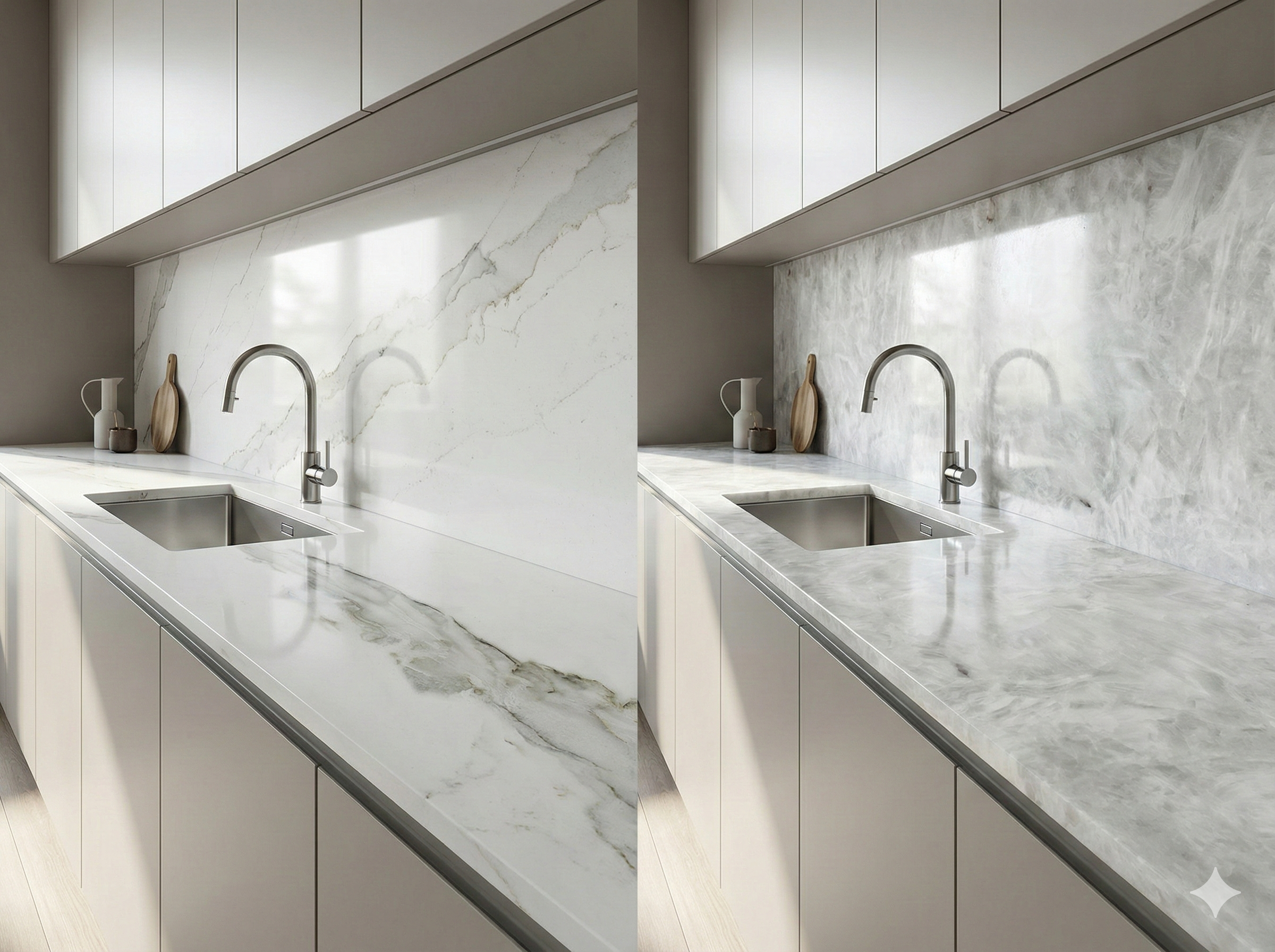
The Origin Story: How They Are Made
To understand how they perform in your kitchen, you have to look at how they started in the ground.
Granite: The Igneous Workhorse
Granite forms from cooling magma deep underground. It’s an igneous rock, meaning it crystallized from molten liquid. This process gives it that classic speckled, granular look. The minerals are tightly interlocked, which makes granite incredibly dense and resistant to water absorption.
Quartzite: The Metamorphic Beauty
Quartzite started its life as sandstone. Under immense heat and pressure within the earth’s crust, that sandstone recrystallized into metamorphic rock. The sand grains fused together to form an extremely hard, glassy network of quartz. This process creates those stunning, marble-like veins that designers love.
Pro Tip: Don’t confuse Quartzite (natural stone) with Quartz (engineered stone). They are completely different materials. Today, we are talking about the natural stuff.
The Durability Test: Which Is Harder?
If you took a geology class, you might remember the Mohs Hardness Scale. It ranks minerals from 1 (Talc) to 10 (Diamond). This scale matters when a kitchen knife slips off your cutting board.
- Granite typically clocks in at a 6 or 7. It’s hard. It won’t scratch easily.
- Quartzite often hits a 7 or 8. It is actually harder than granite and harder than glass.
Does this mean Quartzite is indestructible? Not exactly. While it resists scratching better than almost anything else, hardness isn’t the only factor. We also have to talk about chemistry.
The “Etch” Factor: The Real Difference
This is the most critical part of the Quartzite vs Granite conversation.
Granite is chemically inert to most kitchen acids. Spill lemon juice, vinegar, or tomato sauce on it, and nothing happens. It just sits there until you wipe it up.
Quartzite is mostly silica (which doesn’t react to acid), but some stones labeled as “Soft Quartzite” or “Dolomitic Quartzite” contain traces of calcium carbonate—the same mineral in marble.
- True (Hard) Quartzite: Will not etch. You can leave a lime wedge on it overnight. (Examples: Taj Mahal, Sea Pearl).
- Soft Quartzite: May show dull spots (etching) if exposed to strong acids for too long.
When you view slabs at our Houston Central or Houston North showrooms, ask us specifically about the “acid sensitivity” of the stone you love. We are honest about which is which.
Ready to see the difference yourself? Nothing beats a scratch test. Visit our showroom and let’s look at slabs like Blue Roma and Iceberg up close. Plan Your Visit to Omni Surfaces
Maintenance: Living with Stone in Houston
Houston kitchens see a lot of action—heat, humidity, and heavy cooking. Here is how these stones hold up to real life.
Sealing
Both stones are porous to some degree.
- Granite: Darker granites are very dense and may not need sealing often. Lighter granites are more porous.
- Quartzite: Because it forms from sandstone, some varieties can be thirsty. We recommend a high-quality impregnating sealer upon installation.
Heat Resistance
Both stones are champions here. You can generally place hot pots directly on them without scorching (unlike engineered Quartz). However, we always recommend a trivet to protect the sealer and avoid thermal shock.
Outdoor Kitchens
This is a huge topic in Houston. Both materials are excellent for outdoor patios because they are UV stable. They won’t fade or yellow in the Texas sun. Just remember that darker stones will get very hot to the touch in August.
Comparison at a Glance
| Feature | Granite | Quartzite |
|---|---|---|
| Hardness (Mohs) | 6 – 7 | 7 – 8 |
| Acid Resistance | High (Does not etch) | High (True Quartzite) to Moderate (Soft Quartzite) |
| Look | Speckled, granular, consistent | Veined, flowing, looks like marble |
| Price | $-$$$ (Budget friendly options exist) | $$-$$$$ (Generally premium pricing) |
| Maintenance | Low (Seal every 1-3 years) | Moderate (Seal every 1-2 years) |
Price: What to Expect
Generally speaking, Quartzite commands a higher price point than Granite.
Why? First, quartzite is harder to quarry and harder to cut (fabricators go through more diamond blades cutting it). Second, it offers that coveted “translucent marble look” without the fragility of marble. Stones like Iceberg Quartzite can even be backlit for a dramatic effect—something granite just can’t do.
Granite remains the value king. If you need a bulletproof surface for a rental property, a kid’s bathroom, or a high-traffic laundry room, granite offers incredible performance per dollar.
The Verdict: Which One Should You Buy?
Choose Granite if:
- You want the ultimate “worry-free” surface.
- You appreciate the natural, speckled beauty of earth tones.
- Budget is a primary factor in your renovation.
Choose Quartzite if:
- You love the look of marble but need something stronger.
- You want stunning veins, movement, and light, airy colors.
- You are willing to seal your countertops regularly to protect a premium investment.
At the end of the day, both are excellent choices that add real value to your home. The “best” stone is the one that makes you smile every time you walk into your kitchen.
Still undecided? We have over 20,000 slabs in stock. Come walk the aisles. Sometimes you don’t choose the stone; the stone chooses you. Browse Our Quartzite Collection | Get Directions to Showroom
Frequently Asked Questions
Is quartzite harder than granite? Yes, true quartzite is harder than granite. On the Mohs scale of hardness, quartzite typically scores around 7-8, while granite scores around 6-7. This makes quartzite extremely resistant to scratching.
Does quartzite etch like marble? True quartzite does not etch. However, some stones labeled as “soft quartzite” may contain calcium carbonate and can react to acids. Always ask your stone consultant to verify the specific stone’s properties.
Do I need to seal granite and quartzite? Yes, both are natural stones and have some level of porosity. We recommend sealing them upon installation and resealing every 1-3 years depending on the specific stone and amount of use.
Can I use quartzite in an outdoor kitchen in Houston? Absolutely. Quartzite is UV resistant and will not fade in the sun, making it an excellent choice for uncovered outdoor patios and kitchens in the Houston climate.
Recommended Internal Links: