
Most stone reads by reflected light. Onyx is different — it reads by light passing through it. That’s the whole appeal of onyx backlit feature wall design: instead of a surface you look at, you get a surface that glows, with every vein and color band lit from behind like stained glass. For designers chasing the moment a client stops mid-walkthrough and says “wait, what is that,” this is one of the most reliable ways to get it.
We get asked about this a lot, so here’s what it actually takes to spec one well — the material science, the lighting, the applications that earn the investment, and the questions worth asking before you commit a client’s budget to it.
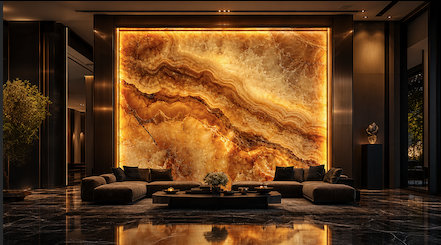
What Makes Onyx Different
Onyx is a calcite-based stone, softer than granite or quartzite, and that softness is precisely why it behaves the way it does. Its crystalline structure is loose enough to let light travel through the slab, especially at thinner cuts, revealing internal color banding that stays completely hidden under normal room lighting. Cut a slab of honey onyx and set it on a shelf, and it looks like warm amber stone. Put an LED panel behind it, and it becomes something closer to liquid gold with visible movement inside.
Color family matters here more than with most stones, because it changes the mood of the whole room:
- Honey onyx glows warm and amber — the most forgiving choice for living rooms and dining spaces
- Blue onyx reads cool and almost oceanic, striking in bathrooms and spa settings
- Green onyx leans natural and grounding, a good fit for lobbies and biophilic-leaning interiors
None of this comes through in a catalog photo. It only shows up with light behind the slab, which is exactly why so many designers make the trip to see it in person before specifying.
Getting the Onyx Backlit Feature Wall Design Right
The look is dramatic, but the build is technical, and this is where a lot of projects go sideways if the wrong questions get asked too late.
Thickness and structure. Most backlit walls run on 2 cm slabs; thinner cuts transmit more light but need a supporting substrate — usually a resin-backed panel or honeycomb core — to stay rigid once it’s mounted vertically. This isn’t optional for anything larger than a small accent panel.
Light source and placement. Even, diffused LED panels behind the full slab beat spotlighting almost every time. Uneven light creates hot spots that show up as bright patches rather than a uniform glow, and it’s one of the most common complaints we hear from designers who didn’t spec the lighting alongside the stone. Dimmable systems are worth the upcharge — the same wall can go from a soft daytime presence to a dramatic evening centerpiece with one control.
Vein continuity. If the wall spans more than one slab, bookmatching or sequential lot-matching keeps the veining and light transmission consistent panel to panel. A mismatched lot will glow unevenly even with perfect lighting behind it, because onyx slabs vary in density and translucency even within the same block.
Seams and mounting. Because the panel is lit from behind, seam lines and mounting hardware become far more visible than they would on an opaque wall. This is a case where the installer’s experience with backlit stone specifically — not just stone in general — makes a real difference in the finished look.
Where This Works Best
Onyx backlit feature wall design earns its cost fastest in spaces built around a single moment of arrival or pause:
- Primary bathrooms, behind a soaking tub or as a full shower-side wall, where steam and warm light both flatter the stone
- Stair landings, where the glow reads from multiple angles as someone moves through the space
- Home bars and wine rooms, where a lit onyx backdrop does double duty as ambiance and display
- Living rooms, as an alternative to a media wall — a fireplace surround backed with onyx skips the TV-wall cliché entirely
- Boutique hospitality and spa reception areas, for commercial designers working in that space
It’s a poor fit for high-traffic, high-contact surfaces. Onyx scratches and etches more easily than granite or quartzite, so we steer clients away from backlit onyx countertops or floors and toward vertical, low-contact applications where the softness of the stone never becomes a liability.
Selecting the Right Slab
This is the step designers skip at their own risk. Two slabs of “honey onyx” from different lots can transmit light completely differently — one glassy and even, another cloudy or veined in a way that reads as noise instead of drama. A few things worth doing before you spec a project around a specific slab:
- Ask for a light-box or phone-torch test on the actual slab, not a sample chip. Translucency doesn’t scale down.
- Confirm lot availability for the full square footage you need, especially for a continuous wall — onyx runs in smaller, more limited lots than marble or granite.
- Check for reinforcement backing already applied, which affects both handling during fabrication and how the finished panel mounts.
- Walk the slab yard in person if the project budget supports it. This is a material where photos genuinely undersell what’s possible, and it’s worth the trip before locking a design.
If bookmatched continuity across a wall is part of the brief, our book-matched slabs guide covers how we tag and hold matched lots — the same lot-matching principles apply here, just with a translucent stone instead of an opaque one. And if you’re still weighing onyx against a more traditional marble statement wall for a client, our marble comparison guide breaks down where Calacatta, Carrara, and Statuario fit instead.
Working With a Houston Supplier
Because onyx is imported in smaller, more variable lots than most engineered or natural stone, sourcing is where projects either come together or stall out. We bring in onyx blocks and slabs directly rather than through a secondary distributor, which means designers can see full lots in person at either Houston showroom rather than working from a sample board and hoping the rest of the slab matches. According to the Natural Stone Institute, onyx’s classification within the broader marble family means it shares some of marble’s care requirements — sealing, pH-neutral cleaners, and protection from acidic spills — which is worth setting client expectations around early, especially for a feature piece meant to last.
If you have a project where a glowing, one-of-a-kind wall is the goal rather than a durable work surface, this is one of the more satisfying materials to specify — and one of the few that photographs worse than it looks in person. Bring us the space and the mood you’re after, and we’ll help you find the slab and the lighting approach to match. Reach out to our design team to see current onyx inventory at either Houston location.