
A waterfall countertop island turns a kitchen island into one continuous piece of stone, letting the slab’s veining flow uninterrupted from the countertop straight down the sides to the floor. It’s one of the most dramatic design choices a Houston homeowner can make during a remodel, and it’s one of the features we get asked about most in both of our showrooms. If you’re weighing whether a waterfall countertop island is right for your kitchen, here’s what you actually need to know before you commit.
What Is a Waterfall Countertop Island?
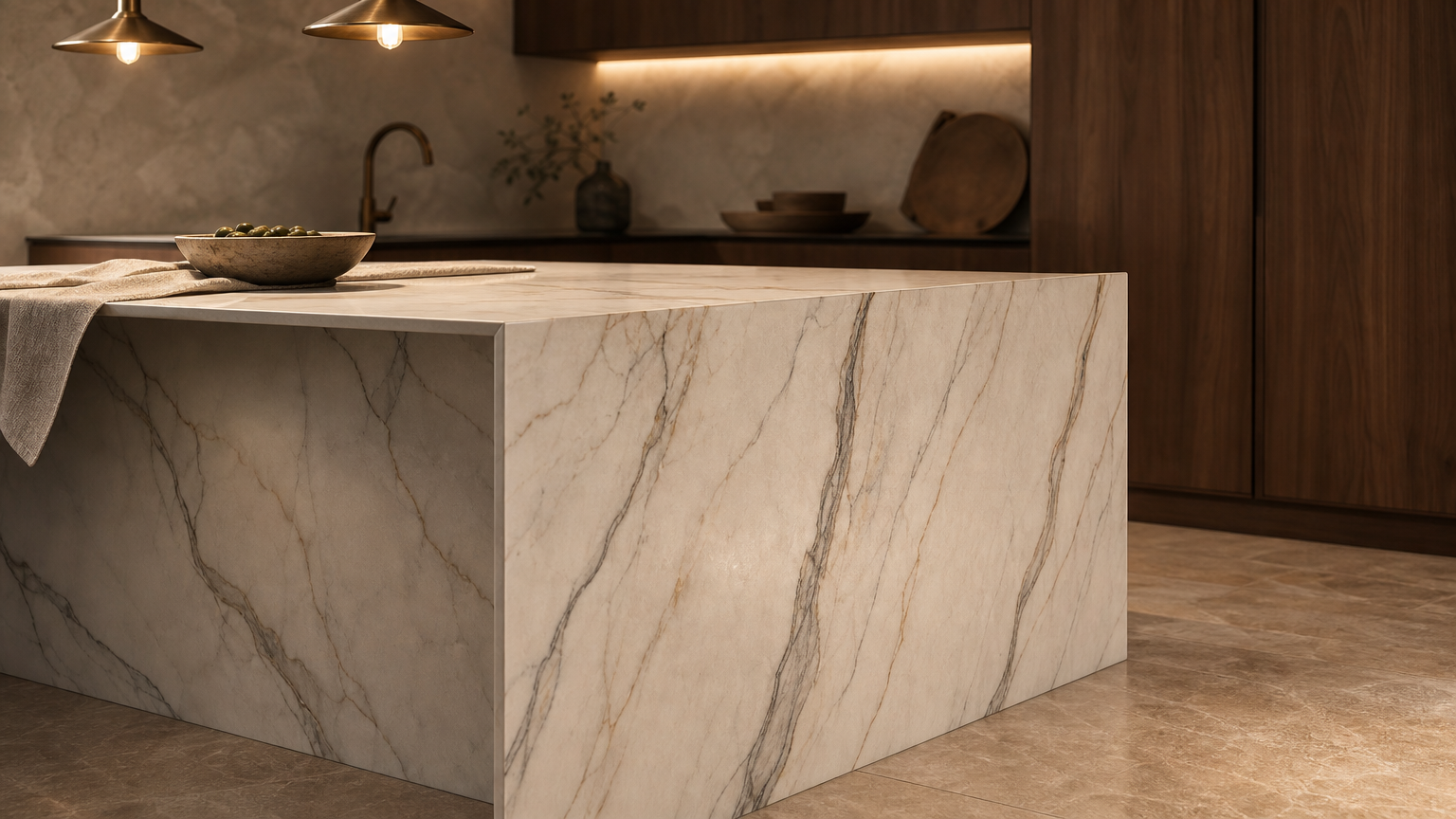
The term “waterfall” describes what happens visually: instead of stopping at the edge of the countertop, the stone wraps over the side and continues down to the floor in a single, mitered panel. Traditional islands end at a squared or eased edge, with cabinetry finished separately below. A waterfall countertop island skips that transition entirely — the slab appears to pour down the side like water, with no visible seam where the horizontal surface meets the vertical one.
Because the side panels are cut from the same slab as the countertop, a well-executed waterfall countertop island reads as one continuous piece of stone rather than a counter sitting on top of a cabinet. That continuity is exactly why the look has become so popular in open-concept kitchens.
Why Houston Homeowners Are Choosing Waterfall Islands
Open floor plans dominate new construction and remodels across Houston, and kitchen islands have grown to match — bigger footprints, more seating, more visual weight in the room. A waterfall countertop island gives that larger island a finished, architectural presence instead of looking like a slab set on a box.
It also plays well with the natural stone patterns homeowners are gravitating toward right now. Bold veining that might feel busy on a small vanity becomes the entire point on a waterfall island, especially when the pattern is matched so it lines up across the corner. For Houston kitchens that open directly into living and dining spaces, a waterfall island often functions as the visual anchor for the whole first floor — which is a lot of pressure to put on one design decision, and part of why we recommend seeing full slabs in person before choosing.
Picking the Right Slab for a Waterfall Countertop Island
Not every slab works equally well for this application, and this is where a lot of homeowners get surprised mid-project. A waterfall countertop island needs enough material from a single slab (or a carefully matched pair) to cover the countertop and both side panels with veining that lines up convincingly. That means yield planning matters more here than on a standard countertop — your fabricator needs to see the whole slab and map out the cuts before anything gets touched.
Natural stone options like quartzite bring the most dramatic veining for this look. Our buyer’s guide to quartzite countertops in Houston covers the range of patterns available, and a stone like Blue Roma quartzite — with its bold blue-and-gold movement — is a slab we specifically point homeowners toward for islands because the veining reads so well on a large, continuous surface.
If you’d rather not deal with sealing or want more consistency across the slab, engineered stone is a solid path for a waterfall design. The uniform pattern makes it easier to match panels precisely, since you’re not relying on the same natural variation you’d manage with quarried stone.
Whichever material you land on, ask your fabricator how they plan to support the structure. The Natural Stone Institute publishes fabrication and installation guidance that reputable stone yards and fabricators follow, particularly around bracing and support for large mitered panels — a waterfall edge carries real weight, and it needs a substrate built to hold it.
Book-Matching a Waterfall Countertop Island
Book-matching takes the waterfall concept a step further. Instead of just continuing the stone down the side, the veining is mirrored across the corner, so the pattern folds like an open book rather than simply repeating. It’s a more involved cut, and it depends entirely on selecting a slab (or sequential slabs from the same block) with movement dramatic enough to make the mirroring worth it.
We’ve written before about how book-matching transforms a bold marble like Calacata Viola into a feature that functions almost like art. The same principle applies directly to a waterfall island — the corner becomes the focal point of the whole kitchen, which is exactly why homeowners chasing this look need to see the actual slab, not a sample chip, before deciding.
Waterfall Countertop Island Installation: What to Expect
Getting a waterfall countertop island installed correctly comes down to three things: seam placement, edge miters, and structural support.
Seams are unavoidable on most islands unless the slab is large enough to wrap the entire structure in one piece, which is rare. A good fabricator places seams where they’re least visible — typically at the back corner, away from the main sightline — rather than centered on the waterfall face itself.
The miter itself is a 45-degree cut on both the countertop and the side panel, joined so the veining appears continuous across the corner. This is precision work; a slightly off angle or a poorly matched pattern is immediately noticeable on a feature this prominent.
Thickness matters too. Waterfall panels are typically fabricated at a full 3cm rather than the thinner options sometimes used on standard countertops, since the vertical panel needs to support its own weight without additional backing in most cases. Your fabricator will walk you through what your specific cabinetry and island size require.
Pairing a Waterfall Island With the Rest of Your Kitchen
A waterfall countertop island is bold enough that it usually dictates the rest of the room, rather than the other way around. Cabinetry tends to work best in a supporting role — simple slab-front cabinets in a neutral tone let the stone stay the star, while busier cabinet detailing can compete with the veining instead of framing it.
Backsplash is where homeowners most often ask us for direction. Matching the backsplash to the island can create a fully immersive, monochromatic look, while a contrasting backsplash lets the waterfall island stand alone as the singular statement piece. Neither is wrong — it depends on whether you want the whole kitchen to feel like one material story or want the island to read as a distinct feature.
Waterfall Countertop Island FAQs
Does a waterfall countertop island use more slab material than a standard countertop?
Yes. Because the side panels are cut from the same slab as the countertop to keep veining continuous, a waterfall design requires more material yield than a standard countertop with a separate cabinet base.
Which stone works best for a waterfall countertop island?
Quartzite and marble offer the most dramatic natural veining for this application, while engineered quartz gives you more predictable pattern matching across panels. The right choice depends on how bold you want the corner detail to read and how much maintenance you’re comfortable with.
Can any kitchen island be converted to a waterfall design?
Not always. The cabinetry needs to be built (or reinforced) to support the weight and structure of full-height stone panels, so this is easier to plan during a full remodel than to retrofit onto an existing island.
Visit Omni Surfaces to Design Your Waterfall Countertop Island
A waterfall countertop island is one of those features where seeing the actual slab changes everything — photos rarely capture how the veining will fold across a real corner in your kitchen. Stop by our Houston Central or Houston North showroom, and our team can walk you through slab options, yield planning, and which materials will give you the waterfall look you’re picturing. Call us or stop in to start mapping out your island.