
You’re specifying a 10-foot lobby wall in a River Oaks high-rise or a continuous retail floor in Uptown, and the last thing you want is a seam breaking the visual line. For architects who demand large-format performance with design flexibility, Laminam porcelain slabs have become the go-to specification. They combine the slab sizes your projects require with the technical rigor your specs demand — and they’re available locally at Omni Surfaces.
Why Laminam Stands Apart for Architectural Applications
Not all porcelain slabs are created equal. Laminam is an Italian brand known for pushing the limits of sintered stone technology. Their proprietary manufacturing process produces slabs in sizes up to 162″ x 65″ — ideal for seamless wall cladding, continuous flooring runs, and oversized countertops in both commercial and residential contexts.
Key technical specs architects care about:
- Thickness options: 5mm, 6mm, 12mm, and 20mm — thin enough for cladding overlays, thick enough for heavy-use countertops
- Flexural strength: >50 MPa, meeting demands for vertical and horizontal applications
- Frost resistance: Fully UV-stable and freeze-thaw resistant, suitable for wild temperature swings
- Hardness: Mohs scale 7 — stands up to high-traffic commercial environments
- Slab dimensions: Up to 3.2m x 1.6m, reducing grout lines and joint frequency
Pro Tip: When specifying for exterior facades, opt for the 5mm or 6mm Laminam thickness with a ventilated façade system. The reduced weight load on the substructure can simplify your engineering requirements significantly compared to natural stone cladding.
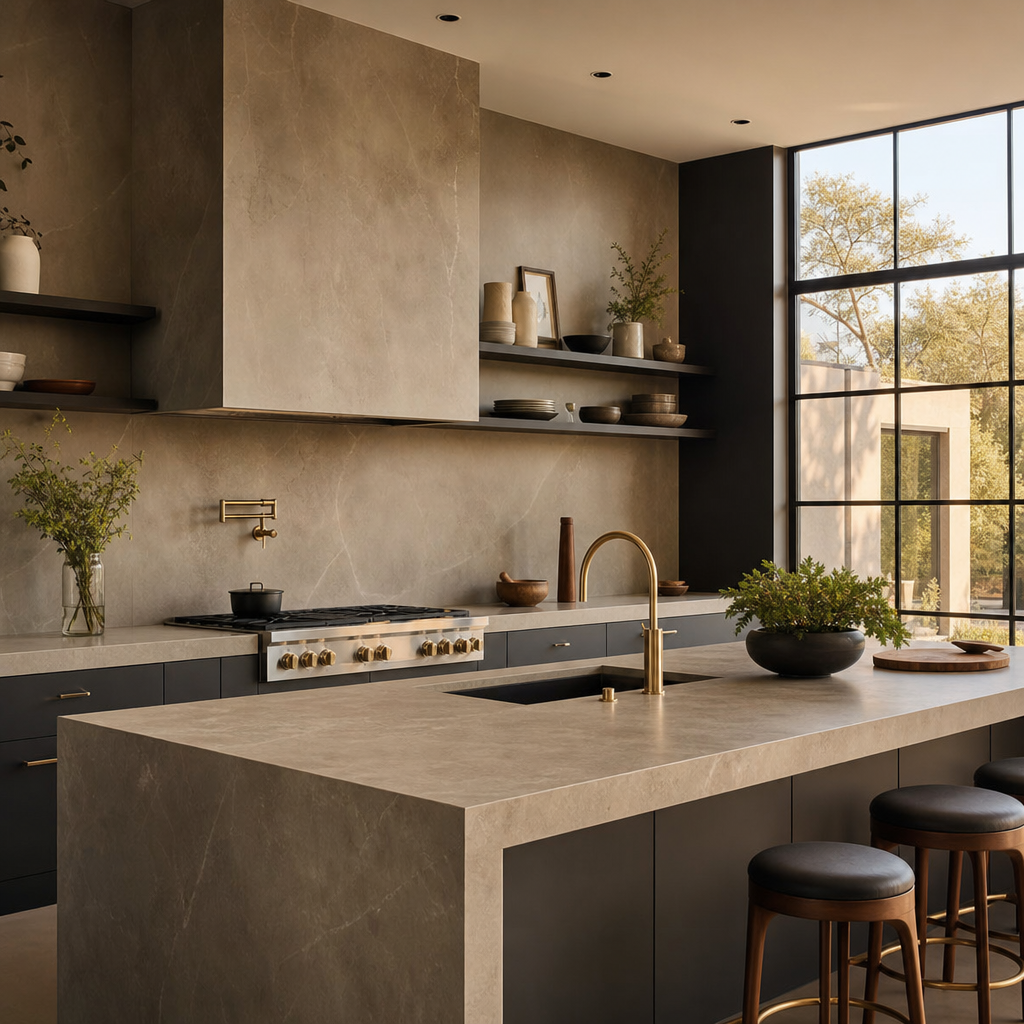
Laminam vs. Natural Stone: What Every Architect Should Consider
Houston architects often ask whether porcelain slabs can truly replace marble, granite, or quartzite in their specifications. The honest answer: for some applications, Laminam outperforms natural stone. For others, natural stone still wins.
Where Laminam excels:
- Consistency across lots: Natural stone varies slab to slab. Laminam offers repeatable patterns across multiple project phases — critical when you’re sourcing for phased builds or future expansions
- Zero porosity: With water absorption below 0.1%, Laminam requires no sealing and won’t stain — a major advantage in healthcare, food-service, or high-end restaurant projects
- Large-format availability: Finding natural stone slabs over 120″ with consistent veining is difficult and expensive. Laminam delivers oversized slabs reliably
- Thin profile for renovations: The 5mm and 6mm options can be installed over existing surfaces, reducing demolition and structural reinforcement costs
Where natural stone wins:
- Unique veining and character that can’t be replicated
- Through-body color that extends through the full thickness
- The “hand-feel” and warmth that some clients prefer
For Houston architects, the decision often comes down to application-specific performance can help you weigh options for specific project types.
Specifying Laminam for the Perfect Projects, Climate and Logistics
Texas’ environment presents unique challenges for architectural materials: extreme heat, high humidity, occasional freezes, and the ever-present risk of hurricane-driven moisture. Laminam’s technical profile addresses all of these.
Specific advantages:
- UV stability: Laminam’s digital ceramic inks are UV-resistant, meaning exterior applications won’t fade or yellow under the Texas sun
- Moisture resistance: With near-zero water absorption, Laminam won’t harbor mold or mildew in humid climate — a key consideration for exterior cladding and pool surrounds
- Thermal performance: The material doesn’t expand or contract significantly with temperature changes, reducing the risk of tile pop-up in direct-sunlight applications
- Lead times: As a direct importer with Laminam slabs in stock at both Houston locations, Omni Surfaces helps architects avoid the 8–12 week lead times common with special-order materials
For architects working on LEED-certified projects, Laminam’s manufacturing process includes recycled content and responsible sourcing documentation — making it easier to meet sustainability credits without sacrificing design.
Sourcing Laminam Porcelain Slabs in Houston
When you specify Omni Surfaces as your slab supplier, you’re working with a Houston institution with over 30 years in the industry. Our inventory includes over 20,000 slabs with more than 400 colors and finishes — including one of the largest Laminam selections in Texas.
FAQ — Laminam Porcelain Slabs for Architects
Q: Can Laminam be used for exterior facades in Houston? A: Yes. Laminam’s frost resistance, UV stability, and low water absorption make it suitable for exterior cladding, especially in ventilated façade systems. Always specify the appropriate thickness and installation method for wind-load requirements.
Q: How does Laminam compare to natural stone for commercial flooring? A: Laminam offers superior stain resistance, consistency across large installations, and easier maintenance. Natural stone offers unique veining and through-body color. For high-traffic commercial floors, Laminam is often the more practical choice.
Q: What thickness should I specify for countertops vs. wall cladding? A: For horizontal surfaces like counters and islands, specify 12mm or 20mm. For wall cladding and backsplashes, 5mm or 6mm is sufficient and reduces structural load.
Q: Does Laminam require sealing? A: No. Laminam has near-zero porosity (less than 0.1% water absorption), so it never needs sealing — unlike natural stone.