
If you live in Houston, you already know the truth: the kitchen doesn’t stop at the back door.
One weekend it’s family tacos. The next it’s friends around the grill, kids running in and out, drinks sweating on the counter, and the sun doing what the sun does here—showing up like it has something to prove.
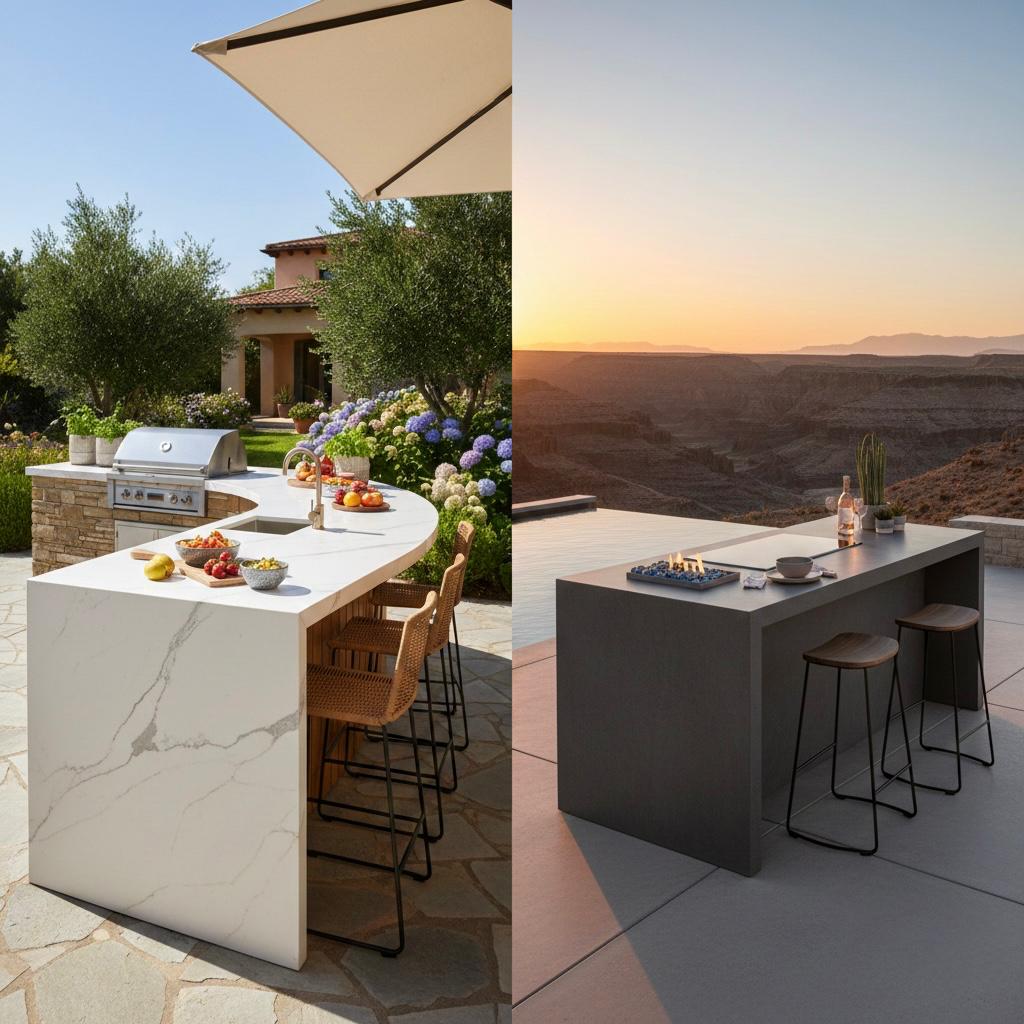
That’s exactly why porcelain countertops (also called sintered stone) are having a moment in Houston. They’re clean, modern, and built for real life—especially when your “kitchen” includes an outdoor bar, a grill station, or a patio that gets full afternoon sun.
Let’s talk about what porcelain does well, where it needs a smarter plan (yes, there are a few things), and how to choose the right slab so you don’t end up with a beautiful surface that makes you nervous.
What are porcelain countertops (and why Houston homeowners care)?
Porcelain countertops are made from refined minerals that are compressed and sintered at very high temperatures. In practical terms, that manufacturing process creates a surface that’s built to handle:
- Heat (hot cookware moments happen)
- Sun/UV exposure (outdoor kitchens are real in Houston)
- Stains (life is messy, countertops shouldn’t be fragile)
- Low maintenance (because nobody has time for constant babysitting)
In Houston, porcelain earns its reputation mainly because it fits how people actually live here: indoor-outdoor flow, entertaining, and long summers.
Porcelain countertops for outdoor kitchens in Texas
If your project includes an outdoor kitchen, porcelain often rises to the top fast. Here’s why.
Heat resistance: grill life happens
Porcelain is one of the strongest options when heat is part of the daily routine. It’s a great fit near grills and outdoor cooking zones—where “a hot tray will touch the counter” is not a hypothetical.
UV resistance: the sun won’t “yellow” your look
Outdoor surfaces in Houston don’t just deal with heat; they deal with UV exposure. Porcelain holds color and pattern extremely well, which makes it a strong candidate for outdoor use compared with many other “pretty but indoor-only” options.
Low maintenance: outdoor counters should be easy
Outdoor kitchens pick up:
- pollen and dust
- sunscreen fingerprints
- grease splatter
- rain and humidity shifts
Porcelain is a “wipe it and move on” surface. That matters.
Real-world durability: what porcelain handles well (and what it doesn’t)
Let’s keep this grounded in real homes, not showroom fantasy.
What porcelain does really well
Porcelain countertops are typically strong against:
- stains
- scratches (for normal kitchen use)
- heat
- UV
It’s a confident material when you want a clean, modern look that doesn’t come with constant rules.
The honest watch-outs (so you’re not surprised later)
Porcelain is tough, but it isn’t invincible. The two most common real-world issues are:
1) Edge chipping risk
Porcelain can chip on impact, especially on edges and corners. This isn’t a reason to avoid it—it’s a reason to plan it.
How to reduce chip risk:
- Choose an edge profile that protects the corner (your fabricator can guide this)
- Avoid designs with fragile overhang situations
- Use good support and smart layout on long runs
2) Seams and layout matter more than people expect
Porcelain often comes in large formats, which is great. But your layout still decides seam placement, and seam planning is where a project goes from “nice” to “wow.”
A good slab layout considers:
- focal points (island first)
- veining direction (if it’s a marble-look porcelain)
- appliance cutouts and weak spots
- where seams will be least visible in daily life
In other words: porcelain rewards planning.
Porcelain vs other countertop materials (Texas edition)
People usually land on porcelain after considering quartz, natural stones, or both.
If you’re choosing porcelain because you love the marble look
Porcelain gives you that high-end, dramatic look without the same anxiety many homeowners feel about etching or constant upkeep.
If you’re choosing porcelain for outdoor kitchens
This is where porcelain can be a standout. Heat + UV exposure is a real combo in Houston, and porcelain is built for it.
If you’re still deciding between materials, this is a great place to internally link:
- Porcelain vs Quartz
- Quartzite vs Granite
- Sustainable countertops options
How to choose the right porcelain slab in Houston (simple checklist)
When you’re standing in front of slabs, it’s easy to choose with your eyes and forget your future self.
Here’s the quick checklist I use with homeowners:
- Where is it going? Indoor kitchen, outdoor kitchen, or both?
- How much sun hits it? Morning light vs full afternoon Houston sun matters.
- What edge and corners do you need? Kids, bar stools, traffic paths—be honest.
- Do you want polished, matte, or textured? The finish changes the vibe and the day-to-day “feel.”
- What’s your seam tolerance? Some people notice seams; some never care.
If you want the easiest path, bring a photo of your cabinets/flooring (or a sample). Matching porcelain to undertones is one of those small steps that makes the whole kitchen look more expensive.
See porcelain slabs in person at Omni Surfaces (Houston Central & Houston North)
Porcelain looks different in real light than on a screen. The veining, the finish, and the scale of the pattern only click when you see a full slab.
If you’re researching porcelain countertops in Houston—especially for an outdoor kitchen—visit Omni Surfaces at Houston Central or Houston North. We’ll help you compare finishes, plan seams, and choose a slab that fits both your design and your day-to-day life.
CTA (meio do post):
Want an outdoor countertop that won’t flinch in Houston sun? Come compare porcelain slabs in person.
CTA (final do post):
Bring a cabinet sample or a few photos—our team can recommend porcelain options that match your exact style.
Frequently Asked Questions (FAQ)
Are porcelain countertops good for outdoor kitchens in Houston?
Yes. Porcelain is a strong option for outdoor kitchens because it handles heat and UV exposure well and stays low-maintenance.
Do porcelain countertops chip easily?
Porcelain is durable, but edges can chip from impact. Smart edge selection, good support, and careful seam/layout planning reduce the risk a lot.
Do porcelain countertops need sealing?
Most porcelain surfaces do not need sealing the way many natural stones do. Your fabricator can confirm based on the specific product/finish.
Is porcelain the same as sintered stone?
They’re often used interchangeably in the countertop world. Many “sintered stone” slabs fall into the porcelain category in everyday showroom language.
Are porcelain countertops heat resistant?
Yes—porcelain is widely chosen for its heat performance, which is a major reason it’s popular near grills and outdoor cooking zones.