
If you’ve stepped into a kitchen showroom lately, you’ve probably noticed something. The cool gray slabs that dominated the last decade are quietly losing ground. In their place, warm quartzite countertops homeowners are requesting show up in nearly every new build and remodel we see coming through our own showroom. People want stone that feels inviting instead of clinical, and quartzite delivers that warmth without giving up an ounce of durability. We’ve watched this shift happen slab by slab at Omni Surfaces, and honestly, it’s one of the more satisfying trends we’ve tracked in years.
What “Warm” Actually Means in a Quartzite Slab
For most of the 2010s, kitchen design leaned hard into gray. Cool grays, icy whites, blue-toned veining — that was the look everyone wanted, and quartzite followed the same pattern. Slabs like Super White or White Macaubas dominated showroom floors for years.
That’s changing now. The quartzite getting requested most often leans into honey, caramel, and soft gold tones instead. Picture a warm cream background with amber veining running through it, or a pale beige base streaked with soft brown movement. Taj Mahal quartzite is probably the clearest example of the shift — its warm, flowing pattern has become something of a signature look for 2026, and it’s easy to see why. It photographs beautifully, it pairs with almost any cabinet color, and it doesn’t feel stark the way a lot of older stone choices did.
There’s a practical reason behind the shift too. Warm tones hide the small stuff — a little dust, a water spot, everyday kitchen chaos — better than a stark white ever could. A busy kitchen doesn’t need to look flawless every second of the day, and this is exactly why more homeowners are choosing warm quartzite countertops for their next remodel.
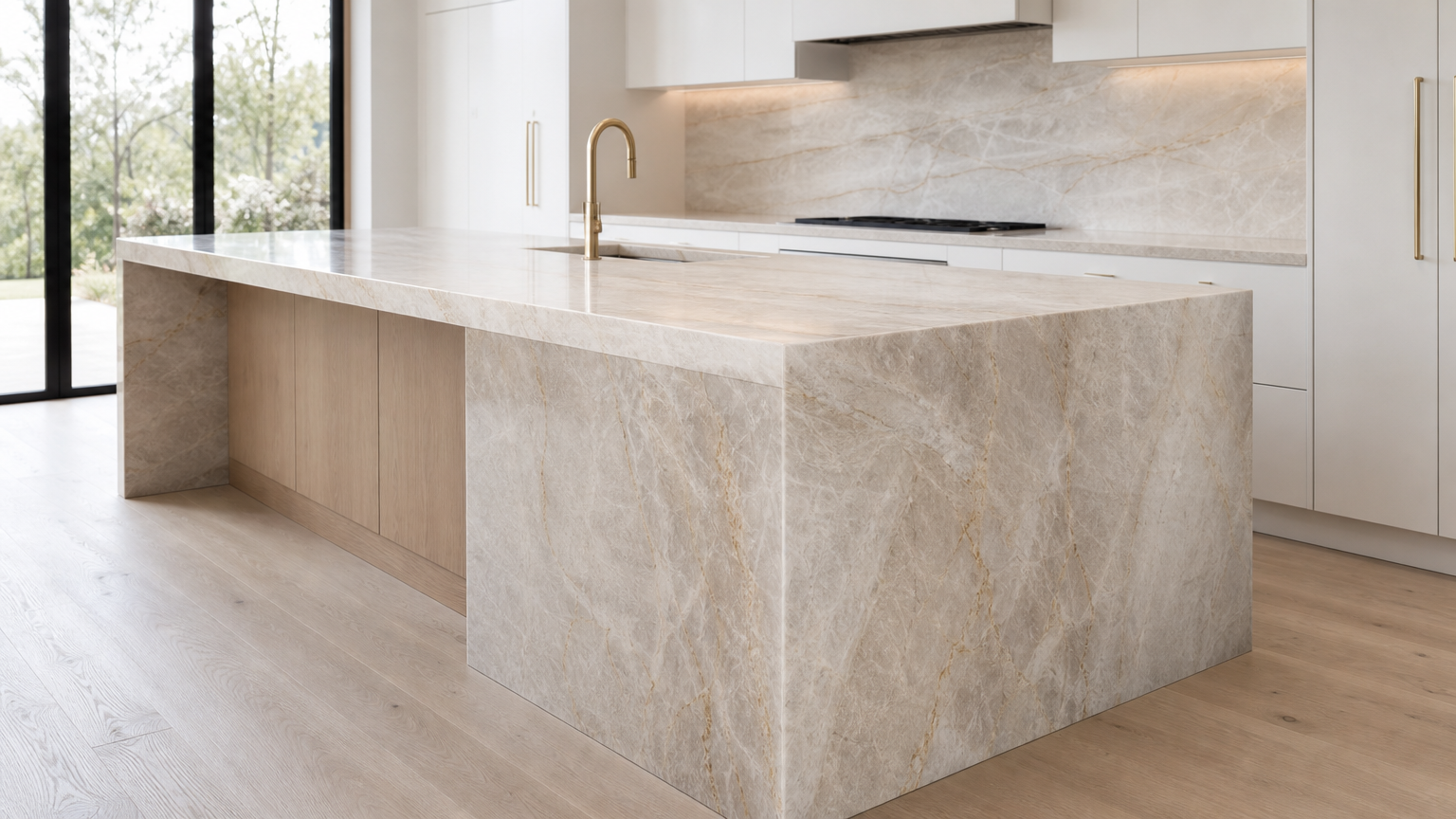
Why Warm Quartzite Works So Well in a Kitchen
Texas isn’t a gentle climate for building materials. Summers run long, humidity sits at almost every corner of the year, and a kitchen countertop needs to hold up to more than knife scratches and hot pans. Quartzite happens to handle exactly that kind of daily pressure well.
Quartzite forms when sandstone gets pushed through extreme heat and pressure deep underground, and that process is what makes it so much harder than marble and, in most cases, tougher than granite too. According to the Natural Stone Institute, quartzite typically ranks between 7 and 7.5 on the Mohs hardness scale, putting it just below diamond-adjacent materials in everyday durability terms. That hardness translates directly into scratch resistance and heat tolerance, two things that matter constantly in a working Texas kitchen. Set a hot pan down without a trivet? Quartzite shrugs it off in a way a lot of engineered surfaces can’t.
💡 Pro Tip: Quartzite still needs sealing, unlike engineered quartz, but it resists etching from lemon juice, wine, and vinegar far better than marble does. A once-a-year reseal is usually all a kitchen needs to keep the surface performing well. That combination of hardness and heat tolerance is exactly why warm quartzite countertops builders spec so often for busy family kitchens.
Quartzite vs. Granite vs. Quartz: A Quick Reality Check
It’s easy to lump these three together at first glance, but they behave very differently once they’re installed.
- Quartzite is a natural stone. It’s harder than granite, resists heat exceptionally well, and needs annual sealing.
- Granite is also natural and heat-resistant, but it’s slightly softer than quartzite and shows more variation slab to slab.
- Quartz is engineered rather than quarried. Manufacturers mix crushed quartz with resin, so it never needs sealing, but it can’t handle direct heat the way natural stone can.
If you want a deeper technical breakdown of how these materials compare for your specific project, our countertop material specification guide walks through the differences in more detail.
None of these is objectively “better.” The right choice depends on what matters more to you: the character of natural veining, or the low-maintenance consistency of an engineered surface. What we tell people who walk into our showroom undecided is this — if you love the movement in the stone and don’t mind a quick yearly reseal, quartzite gives you something a factory-made surface just can’t replicate.
The Warm Quartzite Slabs Homeowners Are Asking For
A few specific slabs keep coming up in conversations at our Houston Central and Houston North locations right now:
Taj Mahal Quartzite — Soft cream base, gentle gold and honey veining. This one’s driving most of the current demand, and for good reason.
Sea Pearl Quartzite — A creamier, more muted option with subtle gray-gold movement that works beautifully in transitional kitchens.
Fantasy Gold Quartzite — Bolder veining for homeowners who want the warmth but still want the slab to make a statement.
Because Omni Surfaces imports directly rather than buying through a middleman, we’re able to keep a deep, consistently rotating inventory of these warm-toned slabs in stock. That matters more than people expect. A kitchen island often needs two or three slabs cut from the same block to keep the veining continuous, and that kind of lot matching only works if a supplier actually has the volume on hand.
Ready to See Warm Quartzite Countertops in Houston Kitchens for Yourself?
Photos only tell half the story with natural stone. The way light moves across a quartzite slab, the subtle texture, the way the veining catches your eye from across a room — none of that translates fully to a screen. Visit our Houston Central showroom at 8721 Clay Road or our Houston North location at 802 FM 1960 Road E, and one of our team members will walk you through the current inventory in stock. You can also call us at 713.463.5000 to check availability before you come in. Whatever your timeline looks like, our team can help you find the right warm quartzite countertops Texas kitchens are built around.
Frequently Asked Questions
Is quartzite more expensive than granite? Generally, yes. Quartzite tends to run a bit higher per square foot than granite, mostly because of its rarity and the extra hardness that makes it more labor-intensive to fabricate.
Does warm quartzite fade or change color over time? No. Quartzite is a natural stone, and its color comes from mineral composition rather than surface pigment, so it won’t fade with sunlight or age the way some materials do.
Can I put a hot pot directly on a quartzite countertop? You can, and it’s one of quartzite’s biggest advantages over engineered quartz. It handles direct heat far better than most surfaces, though using a trivet is still good practice for any counter.
How often does quartzite need to be resealed in a kitchen? Most homeowners find that resealing once a year keeps the surface protected, especially given Texas’s humidity. A simple water-bead test on the counter will tell you if it’s time. Check our full FAQ page for more care and maintenance tips on all our stone surfaces.