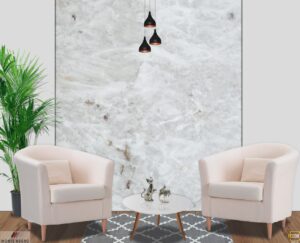
There’s a moment in a slab yard we never get tired of. Two panels come off the same block, we open them like a book, and the veining suddenly mirrors itself down the seam. What was a beautiful stone becomes a piece of architecture. That’s the whole draw of the book matched slabs designers and architects keep coming back to — the stone stops being a surface and starts being the focal point of the room.
This guide is for the people writing stone into the drawings and deciding how it reads on site. We’ll cover what bookmatching actually is, where it earns its keep, and how to spec it so what you fell for in the showroom is what shows up on the wall.
What Book Matching Actually Means
Bookmatching is easy to describe and easy to get wrong. We take two consecutive slabs cut from the same block and flip one, so the two faces mirror each other along a shared edge. Lay a book flat and the two pages are near-identical reflections. Stone does the same thing when it’s cut and sequenced right.
A few terms get used loosely, so it helps to keep them straight:
- Book match — two slabs mirrored along one axis. The classic, symmetrical look.
- Quad match (or quarter match) — four slabs arranged around a center point so the pattern radiates outward. Dramatic, and hungry for material.
- Slip match — slabs set side by side in the same orientation, with the veining continuing rather than mirroring. Softer and more flowing, less formal.
And it isn’t only a marble trick. Quartzite, granite, onyx, and large-format porcelain can all be book matched, as long as the slabs come from the same block or the same production run.
Why Book Matched Slabs Projects Keep Requesting
The payoff is emotional before it’s technical. A book matched wall reads as deliberate — a composition, not a coincidence. People notice it without quite knowing why. For interior designers, that makes it the easiest focal point in the room: one mirrored feature wall behind a bed, a fireplace, or a powder-room vanity, and the whole space has a center of gravity.
Architects tend to reach for it at a different scale. A mirrored slab run in a lobby or reception area sets a tone the second someone walks in, and that symmetry carries a sense of craft flat cladding can’t fake. In hospitality and retail, that first impression is the brand. And because the effect comes from the stone itself, it ages far better than a trend finish — which is part of why the book matched slabs developers spec tend to hold their value as the building does.
Where Book Matched Slabs Earn Their Keep
Bookmatching isn’t right for every surface. It shines where you want a single, uninterrupted statement:
- Feature and fireplace walls. The most common use, and the most forgiving — vertical surfaces take the drama without the wear.
- Waterfall islands and vanities. Mirror the veining over the edge and the stone looks carved from one piece.
- Commercial lobbies and hospitality. Big vertical spans where continuity quietly signals quality.
- Showers and wet areas. Gorgeous, but plan for sealing and the right material — more on that below.
How to Specify Book Matched Slabs Without Surprises
Here’s where good intentions go sideways. The book matched slabs Houston fabricators handle every week still come with a few non-negotiables, because the effect lives or dies on decisions made before anyone cuts.
Buy sequential slabs from one block. You can’t book match two random slabs that happen to look alike. The mirror only works with consecutive cuts, so reserve the full bundle you need up front — plus overage for fabrication and any future repairs.
See it dry-laid before fabrication starts. Always view the slabs stood or laid side by side, in the orientation they’ll install, before a blade touches them. Veining that looks balanced flat on a rack can feel top-heavy once it’s vertical. This one step prevents more regret than any other.
Mind the substrate and the seam. On large runs, the wall behind the stone matters as much as the stone. Architects should hold the substrate to a tight flatness tolerance so the panels sit true and the mirror line stays honest.
Match the material to the use. Marble gives you the boldest veining but wants sealing and care. Quartzite is harder and more forgiving for high-traffic or wet zones — the same durability logic we get into for large-scale construction projects. And book matched porcelain, like the large-format Laminam we break down in our architect’s guide to porcelain slabs, mirrors beautifully with near-zero maintenance — which is why it keeps turning up in restaurants and healthcare.
On upkeep, the Natural Stone Institute is the reference we point specifiers to for sealing and maintenance standards, so a wall still looks like day one ten years on.
Choosing Stone to Book Match
Some stones were made for this. The best candidates have bold, directional veining that reads clearly when mirrored — dramatically veined marbles like Calacatta, translucent quartzites you can backlight like onyx, and rich dolomites. Subtle, uniform stones lose the effect. The drama is the point, and it’s a big part of the 2026 move toward tactile, natural surfaces designers are leaning into.
This is where buying local pays off. We keep more than 20,000 slabs in climate-controlled inventory across our two Houston showrooms, so you and your client can walk the yard, pull consecutive slabs, and dry-lay a book match in person — not approve it from a phone photo. When designers ask us where to find book matched slabs Texas clients will genuinely fall for, that hands-on selection is the honest answer. Recent arrivals like Calacatta Viola and our translucent quartzite are exactly the kind of high-drama material that rewards the technique.
Ready to Design Your Statement Wall?
A book matched feature is one of those details clients remember years later — but only when the selection is done right. That’s the part we love. Come see the inventory in person, bring your drawings or your mood board, and we’ll help you pull and dry-lay the slabs before a single cut. Browse the stone gallery to start narrowing candidates, or get in touch to book a visit at either Houston location.
The book matched slabs designers and architects trust all start the same way: with the right block, seen in person, and sequenced with intention. We’ll help you get there.