
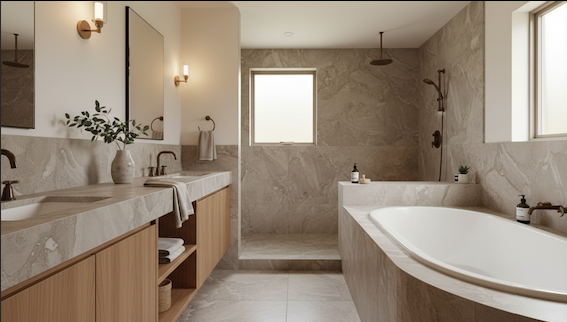
Should your kitchen and bathroom countertops match? It’s one of the most common questions homeowners ask once a renovation moves past a single room. Matching kitchen and bathroom countertops sounds simple in theory, but the two rooms live different lives. A kitchen slab meets knives, hot pans, and red wine. A bathroom slab meets makeup, skincare acids, and standing water. The smarter question isn’t whether to match. It’s how to connect the two rooms without asking one material to survive two very different jobs.
Here’s a framework for getting that connection right, plus where a little contrast actually works in your favor.
Why Homeowners Reach for the Same Stone Twice
The instinct to match makes sense. A home with one clear material story feels finished in a way that a house full of unrelated choices never quite does. Walk from a kitchen with warm, veined quartzite into a bathroom with a completely different countertop. The transition can feel like two separate design decisions instead of one home.
That instinct is worth honoring. It just doesn’t require literally reusing the same slab in every room. A shared material vocabulary, not an identical one, gets you the same payoff with far less risk.
Echo, Don’t Clone: A Better Framework Than Matching Kitchen and Bathroom Countertops Slab-for-Slab
Think of your home’s stone the way a good wardrobe works. A capsule wardrobe doesn’t put everyone in the exact same shirt. It repeats a color story and a few textures across different pieces, so everything reads as one collection even though no two items are identical.
Apply that logic to matching kitchen and bathroom countertops. Instead of cutting the same quartzite for the kitchen island and every bathroom vanity, carry over the undertone, the vein density, or the finish. Let the specific stone flex room to room. A warm, taupe-veined quartzite in the kitchen might show up as a calmer, tighter-veined quartzite in the primary bathroom and a solid-toned quartz in a powder room. The eye reads all three as related. No two rooms had to compromise on performance to get there.
This approach also solves a practical problem: kitchen counters typically run bigger and pull from bigger, bolder slabs, while a bathroom vanity is a much smaller canvas. A pattern that reads beautifully across nine feet of island can feel chaotic squeezed onto a 30-inch vanity. Echoing tone and finish, rather than matching the exact slab, lets each surface work at its own scale.
Which Materials Actually Travel Well From Kitchen to Bath
[IMAGE PLACEHOLDER — material comparison across rooms] Suggested filename: kitchen-bathroom-countertop-material-comparison.jpg Suggested alt text: “Granite, quartz, and quartzite samples for matching kitchen and bathroom countertops”
Not every material performs the same way in both rooms, so the “echo” needs to account for what each surface has to survive.
Granite handles heat and knives in the kitchen better than almost anything else. That same toughness makes it a durable, low-drama choice for a bathroom vanity, even one that sees hairspray and nail polish remover regularly. Our durable kitchen countertop slabs collection shows the range of colors available if granite is the anchor for your material story.
Engineered quartz is arguably the easiest material to carry across the whole house. It doesn’t need sealing, and it holds its color under both cooking activity and daily skincare products. It also comes in consistent enough batches that a kitchen slab and a bathroom slab from the same line read as close cousins, even if they’re not literally the same piece.
Marble earns its place in bathrooms more comfortably than in kitchens. Cosmetics and skincare are gentler on a vanity than lemon juice and red wine are on an island. A marble-adjacent kitchen surface, paired with true marble in the primary bath, is a common and successful version of the echo approach.
Quartzite may be the single best material for matching kitchen and bathroom countertops, because it performs well in both settings. It brings marble-like veining to a kitchen island with genuine heat and scratch resistance. That same durability holds up just as well against a bathroom’s daily lineup of products and moisture. Browse our bathroom countertop options to compare tones against whatever quartzite or granite you’re considering for the kitchen.
Three Formulas for Connecting Kitchen and Bathroom Countertops
If you want a starting point rather than a blank slate, these combinations consistently work:
- Same family, different scale. Choose one quartzite or granite family for the kitchen island, then select a calmer, more subdued slab from the same family for bathroom vanities. The mineral makeup and undertone match; the drama scales down with the room.
- Stone in the kitchen, stone-look porcelain in the bath. Keep a natural stone island as the showpiece, and use a large-format porcelain in a matching tone for bathroom vanities and shower walls. This keeps material cost and maintenance lower in the rooms that see the most daily moisture, without breaking the visual story.
- One neutral, one accent, repeated. Pick a neutral engineered quartz for the bulk of both kitchen and bathroom surfaces. Then repeat a single bold natural stone accent, such as a waterfall island edge and a bathroom accent wall, as the connective thread between rooms.
Common Mistakes When Matching Kitchen and Bathroom Countertops
A few missteps show up again and again in renovations that try to unify a home’s stone:
- Choosing the kitchen slab first, then hunting for a “close enough” bathroom match. Slab dye lots and quarry batches shift over time. Select both spaces from the same buying trip when true matching matters, and lean on the echo approach when it doesn’t.
- Ignoring scale. A bold, high-contrast pattern that anchors a large island can overwhelm a small vanity. Ask to see a full slab, not a sample chip, laid against your actual vanity dimensions before committing.
- Forgetting the finish. Tone can match perfectly while a polished kitchen counter and a honed bathroom vanity still read as unrelated. Finish carries as much visual weight as color.
- Treating every bathroom the same. A powder room seen by guests deserves a different level of investment than a secondary bath. Reserve your closest match for the primary bathroom and let smaller baths pick up a simpler, related material instead.
Bringing the Two Rooms Together
Matching kitchen and bathroom countertops, done well, isn’t about forcing one slab to do two jobs. It’s about choosing a material story once and letting it flex intelligently between a room built for cooking and a room built for getting ready. Start with the material that has to work hardest, usually the kitchen, and let the bathroom selections echo its tone, vein character, and finish rather than duplicating it exactly.
Before you commit, see the actual candidates side by side rather than relying on memory or a photo from a different showroom visit. Our room visualizer is a useful first step for testing how a kitchen and bathroom pairing will look together. Use it before you’re standing in front of full slabs.
Frequently Asked Questions
Do kitchen and bathroom countertops have to match exactly? No. Most designers now recommend an “echo” approach instead of matching kitchen and bathroom countertops slab-for-slab. Carrying over tone, vein character, or finish creates a cohesive feel without asking one material to perform in two very different rooms.
What’s the best material for both kitchen and bathroom countertops? Quartzite and engineered quartz both perform well in kitchens and bathrooms. Quartzite offers marble-like veining with strong heat and scratch resistance, while engineered quartz needs no sealing and holds consistent color across multiple rooms.
Should the powder room countertop match the primary bathroom? Not necessarily. Reserve your closest material match for the primary bathroom, since it gets daily use and the most scrutiny. A powder room can pick up a simpler, related material instead of an exact match.
Can I mix natural stone and engineered quartz between rooms? Yes. A common approach keeps a natural stone slab as the kitchen’s centerpiece. It then uses a coordinating engineered quartz in bathrooms, where consistency and lower maintenance matter more than one-of-a-kind veining.