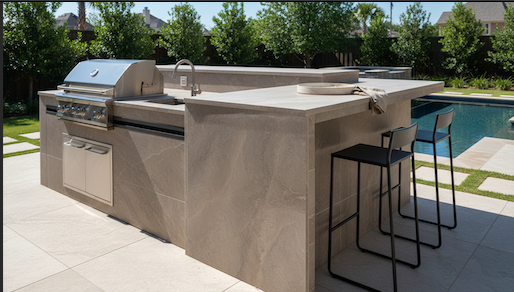
Outdoor BBQ island design used to mean brick, stucco, or whatever material happened to survive rain and sun. That’s changing fast. Homeowners now want their grill island to look like it belongs to the same kitchen as the one indoors. They don’t want a separate structure bolted onto the patio. The result is a wave of outdoor BBQ island design that borrows straight from the kitchen. Waterfall edges, bold veining, and book-matched slabs now show up outside too.
Here’s how that indoor-outdoor connection actually works, and which materials make it possible.
From Occasional Grill Spot to Real Outdoor Room
Outdoor kitchens have shifted from an occasional-use grill station to a genuine extension of the home. Designers now treat the space the same way they’d treat any other room. That means a considered material palette, real storage, and seating that invites people to stay. A pizza oven, a beverage station, or a smoker often joins the grill, turning one appliance into a full outdoor cooking setup.
That shift changes how the island itself gets designed. When an outdoor kitchen reads as a room rather than a chore, the countertop becomes the detail that sets the tone. That’s exactly how it works indoors.
Outdoor BBQ Island Design Borrows From the Kitchen
[IMAGE PLACEHOLDER — detail shot] Suggested filename: book-matched-waterfall-edge-outdoor-bbq-island.jpg Suggested alt text: “Book-matched waterfall edge on an outdoor BBQ island countertop”
Here’s the clearest sign of this shift: waterfall edges and book-matched veining. Once reserved for kitchen islands, they now show up on grill islands too. Picture a slab running down the side of an outdoor island the same way it does indoors. That continuity creates a visual thread between the two spaces. Walk from the kitchen to the patio and the stone doesn’t change character, even if the material technically does.
This doesn’t mean copying the indoor slab exactly. Most indoor island materials, including many marbles and some engineered quartz, aren’t built for direct sun and freeze-thaw cycles. The goal is coordinating tone, veining style, and edge profile. Then choose an exterior-rated material that can deliver the same look outdoors.
Materials Built to Live Outside
Not every countertop material can handle a grill island. A few hold up especially well:
Sintered stone resists UV fading, extreme heat, and moisture without sealing. It won’t swell, warp, or crack from temperature swings. It also comes in finishes that echo natural marble veining, useful for connecting it visually to an indoor slab. Our engineered quartz and sintered stone options include finishes built for exterior use.
Large-format porcelain shares many of the same strengths: non-porous, heat-resistant, and stable through freeze-thaw cycles. It also holds color well in direct sun. That matters for a surface that won’t sit in shade like most indoor countertops do.
Granite remains a dependable, lower-cost option for exterior islands. It handles heat and weather well, though it needs periodic sealing that porcelain and sintered stone don’t. Browse our granite slab selection for exterior-friendly color and pattern options.
Want a deeper material-by-material breakdown, including soapstone and marble trade-offs? See our full outdoor countertop overview.
Designing the Connection, Not Just Matching Colors
A successful indoor-outdoor pairing rarely means using the identical slab in both spaces. Instead, aim for a shared design language:
- Match the edge profile. If the kitchen island has a waterfall edge, echo it outside, even in a different material.
- Coordinate veining intensity, not the exact pattern. A bold, dramatic vein indoors pairs well with a similarly bold (but exterior-rated) vein outdoors.
- Keep the cabinetry tone consistent. Warm wood indoors and out reinforces the connection more than the countertop alone can.
- Let sightlines do the work. A window or sliding door often frames the view from kitchen to patio. Design both islands with that direct sightline in mind.
Bringing the Look Home
Before finalizing an outdoor BBQ island design, look at full slabs of your exterior material. Compare them next to a sample of your indoor countertop. Photos and small chips rarely capture how two different materials will actually read side by side across a sightline. Our team can pull matching sets in sintered stone, porcelain, and granite. You can compare tone and veining before anything gets cut.
Frequently Asked Questions
What is the best material for an outdoor BBQ island? Sintered stone and large-format porcelain perform best outdoors. Both resist UV fading, heat, and freeze-thaw cycling without sealing. Both also come in finishes that can echo an indoor marble or quartzite look.
Can I match my outdoor kitchen island to my indoor one? Not usually with the exact same slab, since most indoor materials aren’t built for direct sun and weather. You can still match the edge profile, veining style, and cabinetry tone with an exterior-rated material.
Is a waterfall edge practical for an outdoor island? Yes, as long as the material is exterior-rated. Sintered stone, porcelain, and granite all handle a waterfall edge outdoors. None carry the durability concerns that limit natural marble in exterior settings.
Do outdoor countertops need sealing? It depends on the material. Granite needs periodic sealing to resist staining. Sintered stone and large-format porcelain are non-porous and don’t require sealing at all.