
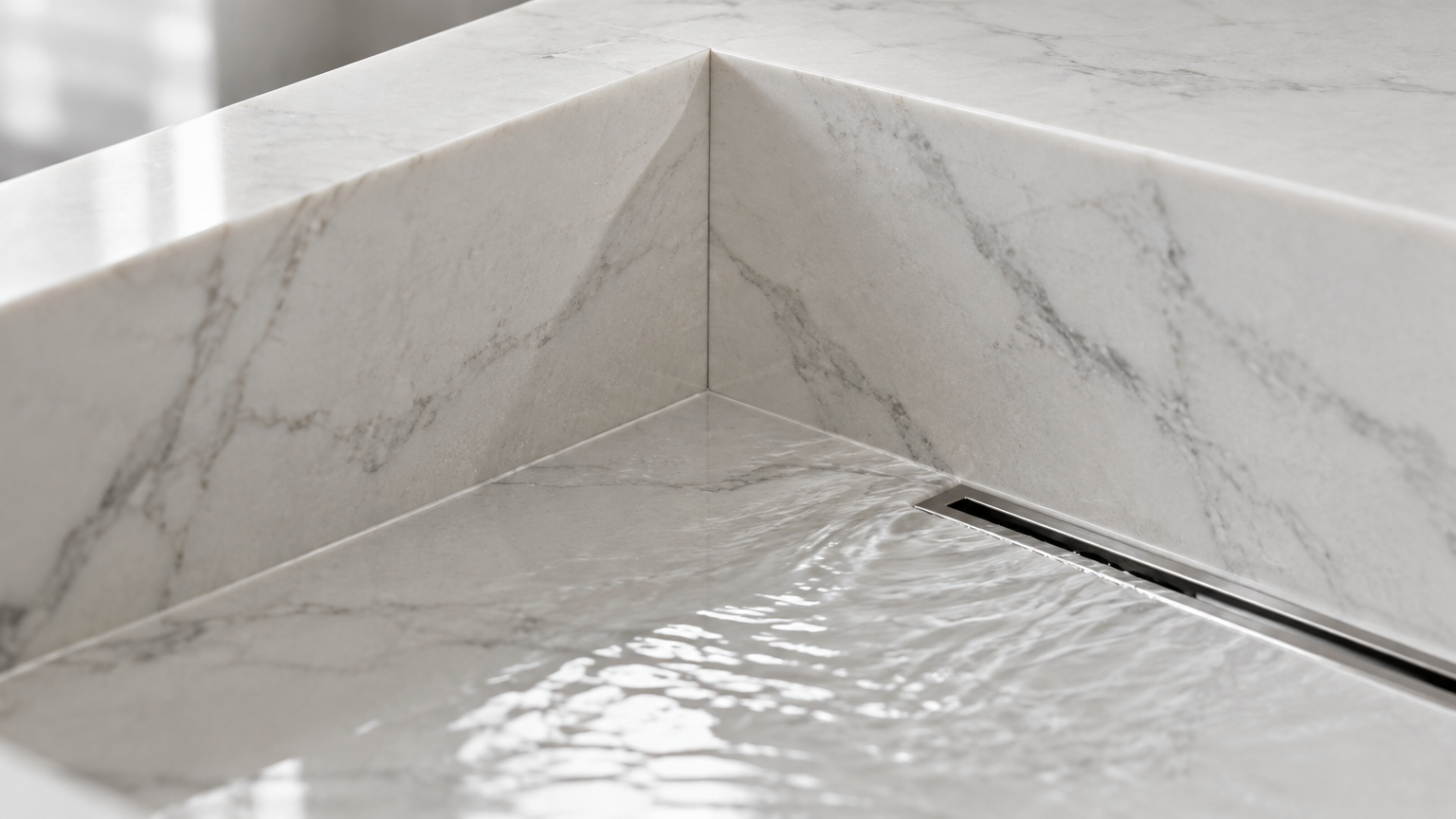
An integrated sink countertop is a sink and countertop made as one continuous piece. There’s no lip, no rim, and no visible joint where the basin meets the counter. The result looks sculpted, and it’s one of the cleanest details you can put in a kitchen or bath.
Here’s how these sinks are made, which materials work best, and what to know before you specify one.
What Is an Integrated Sink Countertop?
With a standard undermount or drop-in sink, the basin is a separate product. It’s attached to the stone with clips, adhesive, or a rim. An integrated sink countertop skips that. The basin is fabricated from the same material as the counter, so the surface flows right into the bowl.
You’ll see two main styles:
- Box or bowl basins. A traditional sink shape with flat walls and a center or offset drain.
- Ramp or sloped basins. A shallow, angled floor that runs water toward a hidden slot drain. These are popular on vanities and in powder rooms.
Both styles hide the drain hardware and remove the grime-catching crevice you get with an undermount sink.
How Integrated Sinks Are Fabricated
Most stone and porcelain integrated sinks are built by a fabricator from slab offcuts. The fabricator cuts the basin walls and floor, miters the corners at 45 degrees, and bonds them with color-matched adhesive. Done well, the joints nearly disappear.
[IMAGE PLACEHOLDER — in-body image, place directly under this H2] Suggested filename: integrated-sink-countertop-mitered-quartz-basin-detail.jpg Suggested alt text: “Close-up of a mitered integrated sink countertop in white quartz showing a seamless basin corner” Suggested caption: “Mitered corners and matched veining make the basin read as one solid block of stone.” AI image prompt:
Photorealistic macro detail photograph of an integrated sink countertop in white quartz with soft gray veining. Close-up of the inside corner of a rectangular basin where two mitered stone panels meet at a crisp 45-degree joint; the veining continues across the joint with almost no visible seam. A thin sheet of water glides down a gently sloped basin floor toward a narrow stainless steel slot drain. Soft directional side light reveals the smooth polished surface and the precision of the joint. Neutral background, shallow depth of field, 90mm macro lens, high-end product photography style. No people, no text, no logos, no brand names. Aspect ratio 4:3.
The craft is in the details:
- Vein matching. On veined stone, the fabricator lays out the cuts so the pattern wraps from the counter down into the basin. This takes planning at the slab stage, much like book-matched slabs for a feature wall.
- Slope and drainage. The basin floor needs enough pitch to drain fully. Standing water leaves mineral rings on any surface.
- Edge work. The counter edge often uses a mitered apron, which makes the top look thick and monolithic. Our post on countertop edge profiles covers the mitered edge in depth.
Because so much depends on the shop, choose a fabricator who can show you finished integrated sinks, not just countertops.
Best Materials for an Integrated Sink Countertop
Not every surface is equally suited to living with water all day.
Porcelain and sintered stone. This is our top pick for an integrated sink. Porcelain is non-porous, resists stains and chemicals, and doesn’t need sealing. Laminam porcelain slabs come in thin, large-format panels that work well for sloped ramp basins and matching wall cladding.
Quartz (engineered stone). Quartz is non-porous and consistent, which makes joints easier to hide. It’s a strong choice for vanities. Check the manufacturer’s guidance on heat and on fabricated sink warranties, since each brand sets its own rules.
Quartzite and granite. Both are hard and dense. With a good seal, they handle daily water exposure well. Expect more maintenance than porcelain or quartz, and reseal on schedule.
Marble. A carved or mitered marble basin is stunning. Still, marble is calcium-based. Toothpaste, soaps, and acidic cleaners can etch it over time. It’s best for powder rooms or guest baths, where use is lighter and the look matters most.
Where an Integrated Sink Countertop Works Best
Bathroom vanities. This is the most common use. A single-slab vanity with an integrated basin makes a small bath feel open and calm. For tight footprints, see our small bathroom vanity slab ideas.
Double vanities. Two basins carved from one long slab create a hotel-suite look. A trough-style sink with two faucets is another option.
Spa-style primary baths. An integrated basin pairs naturally with slab shower walls and matching floors. Our spa bathroom surface pairing framework shows how to keep vanity, wall, and floor in conversation.
Kitchens and prep sinks. Integrated kitchen sinks exist, but they take more abuse. Heavy pots, cast iron, and dropped knives are tough on any surface. Many designers keep the main kitchen sink in stainless or fireclay and use an integrated basin on a bar or prep sink instead.
Commercial and hospitality spaces. Restrooms in hotels, restaurants, and offices use integrated porcelain vanities because they’re quick to clean and have no rim for grime to collect.
Care and Maintenance Tips
An integrated sink countertop is easy to live with once you know the routine.
- Wipe it dry. A quick wipe after use prevents water spots and mineral rings, especially with hard water.
- Use pH-neutral cleaners. Skip bleach and acidic sprays on natural stone. Porcelain and quartz are more forgiving, but gentle cleaners are still best.
- Reseal natural stone. Quartzite, granite, and marble need periodic sealing. Your fabricator will recommend a schedule. The Natural Stone Institute also publishes care guidance.
- Avoid sudden heat shock. Don’t pour boiling water directly onto a cold stone basin.
- Keep the slot drain clear. Ramp sinks have a narrow drain. Lift the cover now and then and clear out hair and debris.
Is an Integrated Sink Countertop Right for Your Project?
Choose one if you want a clean, sculptural look and an easier wipe-down. The tradeoff is that the sink can’t be swapped on its own later, and fabrication takes more time and skill. For most bathrooms, that tradeoff is well worth it.
Ready to see slabs that suit an integrated sink countertop? Contact our team to plan a showroom visit. We’ll help you choose a porcelain, quartz, or natural stone that looks beautiful and holds up to daily water.
Frequently Asked Questions
What is an integrated sink countertop? It’s a countertop and sink made from the same material as one continuous piece. There’s no rim or visible joint between the basin and the counter.
What material is best for an integrated sink? Porcelain and sintered stone are the most durable choices because they’re non-porous and don’t need sealing. Quartz is also a strong option for vanities.
Are integrated sinks hard to clean? No. They’re usually easier to clean than undermount sinks because there’s no crevice where the sink meets the counter.
Can you replace an integrated sink? Not on its own. Since the sink and countertop are one unit, replacing the basin generally means replacing the top. Choose a durable material from the start.
Do integrated sinks work in kitchens? They can, but kitchen sinks take heavy wear from cookware. Many designers prefer an integrated basin for a bar or prep sink and a traditional sink for the main cleanup zone.