Clients keep asking for the same feeling, even when they can’t name it: a bathroom that feels like a private spa, not a functional wet room. Getting there isn’t about any single fixture. It comes down to spa bathroom surface pairing — how deliberately the vanity, shower walls, and floor relate to each other as one material system. That makes it a specification problem as much as a design one.
Here’s a framework for thinking through that pairing. It includes the material considerations worth flagging to clients and fabricators before slabs get cut.
The Shift From Matching to Spa Bathroom Surface Pairing
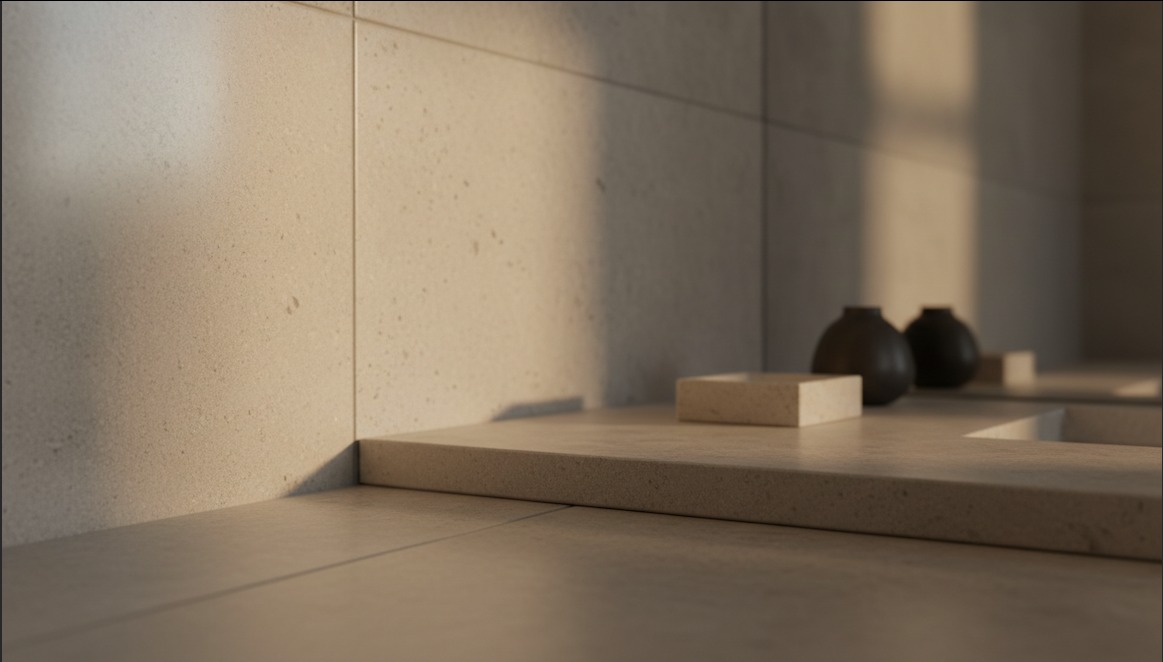
For years, “coordinated” meant one material family repeated everywhere in the same finish. The current direction is more nuanced: continuity, not uniformity. Good spa bathroom surface pairing usually carries one surface — often a stone-look porcelain or a natural stone in a consistent tone — from the vanity area straight into the shower. In wet-room layouts, it extends across the floor too, minimizing the visual breaks between zones.
The goal isn’t eliminating variation entirely. It’s reducing the number of transitions a client’s eye has to process in a small room. Fewer grout lines, fewer material changes, fewer visible seams — all of it reads as calmer. It also tends to make a modest-sized bathroom feel larger.
Vanity Countertops: Natural Stone vs. Engineered Quartz in Wet Environments
[IMAGE PLACEHOLDER — vanity detail] Suggested filename: natural-stone-vanity-spa-bathroom-surface-pairing.jpg Suggested alt text: “Quartzite vanity countertop as part of a spa bathroom surface pairing scheme”
The vanity is usually the anchor surface the rest of the palette gets built around. Specify it deliberately, rather than defaulting to whatever’s left over from the kitchen selection. Browse our bathroom countertop options for a sense of what’s available across natural and engineered stone.
Natural stone — marble, quartzite, and soapstone in particular — brings veining and depth that photograph well and read as genuinely luxurious in person. Quartzite is increasingly the pragmatic choice among these three. It delivers a marble-like look with meaningfully better resistance to the etching and staining that vanity surfaces face from cosmetics, skincare products, and standing water.
Engineered quartz remains the lower-maintenance specification. It matters most for multi-bathroom projects, where color and pattern consistency across several vanities outweighs the one-of-a-kind character of a natural slab. Our engineered quartz slab collection has closed much of the visual gap with natural veined stone. That makes it worth revisiting even for clients who initially ask for “real marble.”
For vanities near a book-matched shower wall or floor transition, match veining direction and tone across both surfaces. Treat them as one selection, not two separate ones. That’s what makes the continuity read intentional instead of coincidental.
Shower Walls: Large-Format Porcelain and Sintered Stone
Shower walls are where large-format porcelain and sintered stone slabs make the strongest case for replacing traditional tile. Oversized panels dramatically cut the number of grout lines in a wet enclosure. That matters both aesthetically and practically: fewer joints mean less maintenance and fewer potential failure points over the life of the installation.
Matte and honed finishes are outperforming high-gloss in current specifications. They diffuse light more naturally and show water spotting and soap film less than polished surfaces do — a meaningful edge for a surface that gets wet daily.
Stone-look porcelain does a lot of the heavy lifting here. It replicates the veining of marble or quartzite closely enough to pair convincingly with a natural stone vanity. It also offers the moisture resistance and lower maintenance that a genuine natural stone shower wall would demand. For projects with tighter budgets or maintenance concerns, this pairing often gets a client to yes. Our natural stone slab selection is a useful reference point when matching tone across a vanity and an adjacent shower wall.
Flooring That Disappears: Continuity From Vanity to Shower
In curbless and wet-room layouts especially, run one flooring material continuously from the dry vanity zone into the shower pan area. Skip the transition to a separate shower floor tile. This single move does the most to make a bathroom feel unified. It also simplifies waterproofing detailing when you specify it early, since it minimizes transition points instead of multiplying them.
A few specification notes worth flagging early in a project:
- Slip resistance in the wet zone typically needs a different finish or texture than the dry-zone flooring, even when the material and color otherwise match. Confirm the coefficient of friction rating for the wet-area portion specifically.
- Radiant floor heating pairs well with continuous stone or porcelain flooring, and clients increasingly request it as part of the “spa” brief. Confirm substrate compatibility before finalizing material thickness.
- Seam and transition placement should follow the slab or tile layout, not arrive as an afterthought. A visible seam at the shower threshold undercuts the continuity the rest of the specification works to create.
Three Spa Bathroom Surface Pairing Formulas Worth Having on Hand
[IMAGE PLACEHOLDER — material pairing flat lay] Suggested filename: spa-bathroom-surface-pairing-material-formulas.jpg Suggested alt text: “Three spa bathroom surface pairing material combinations shown side by side”
When a client brief is light on specifics, these combinations reliably deliver the continuity-driven, spa-inspired result:
- Warm quartzite vanity + matching stone-look porcelain shower walls + continuous matte porcelain flooring. This reads as cohesive and natural, without the maintenance demands of an all-natural-stone room.
- Honed marble or soapstone vanity + large-format sintered stone shower walls in a complementary tone + wood-look porcelain flooring. This introduces contrast deliberately, while keeping the material story simple.
- Engineered quartz vanity + book-matched natural stone accent wall behind the tub or vanity mirror + porcelain field tile elsewhere. This concentrates the design budget into one statement surface, rather than spreading it thin.
Before You Finalize the Spec
Renderings and small-format samples rarely predict how a veined material will read at full scale across multiple surfaces in the same room. Whenever a project calls for continuity between a vanity, a shower wall, and a floor, lay out full slabs side by side before committing — not swatches. Tone and vein direction that look complementary on a sample board can clash once installed at scale.
We regularly pull matching slab sets across natural stone, engineered quartz, and large-format porcelain for exactly this kind of side-by-side review. We can put together spa bathroom surface pairing options suited to a specific brief ahead of a client presentation.
Frequently Asked Questions
What is spa bathroom surface pairing? Spa bathroom surface pairing means coordinating the vanity, shower wall, and flooring materials as one continuous system. It matches tone, veining, and finish across all three, rather than treating each surface as a separate selection.
Is porcelain or natural stone better for shower walls? Large-format porcelain and sintered stone typically need less maintenance and offer better moisture resistance than natural stone. Stone-look porcelain finishes now replicate natural veining closely enough to pair convincingly with a natural stone vanity.
Why is continuous flooring popular in spa-style bathrooms? Running one flooring material from the dry vanity area into the shower zone reduces visual breaks. It also simplifies waterproofing at transition points, which together create a calmer, more unified feel in the room.
Can engineered quartz be paired with natural stone in the same bathroom? Yes. A common approach specifies engineered quartz for the vanity, where consistency across multiple bathrooms matters most. It then reserves a natural stone slab for one statement surface, such as an accent wall, to control cost while still delivering a high-impact material moment.