
The biggest kitchen island countertop trends for 2026 aren’t about doing more — they’re about picking one dramatic material moment and letting it carry the room. A kitchen island used to be judged mostly on square footage. Now it’s judged by the story its stone tells the moment you walk in, which is exactly why waterfall edges, bold veining, and smarter material pairings are dominating this year’s renovations.
Here’s what’s actually showing up in kitchens right now, and how to think about applying it to yours.
2026 Kitchen Island Countertop Trends: The Waterfall Isn’t Going Anywhere
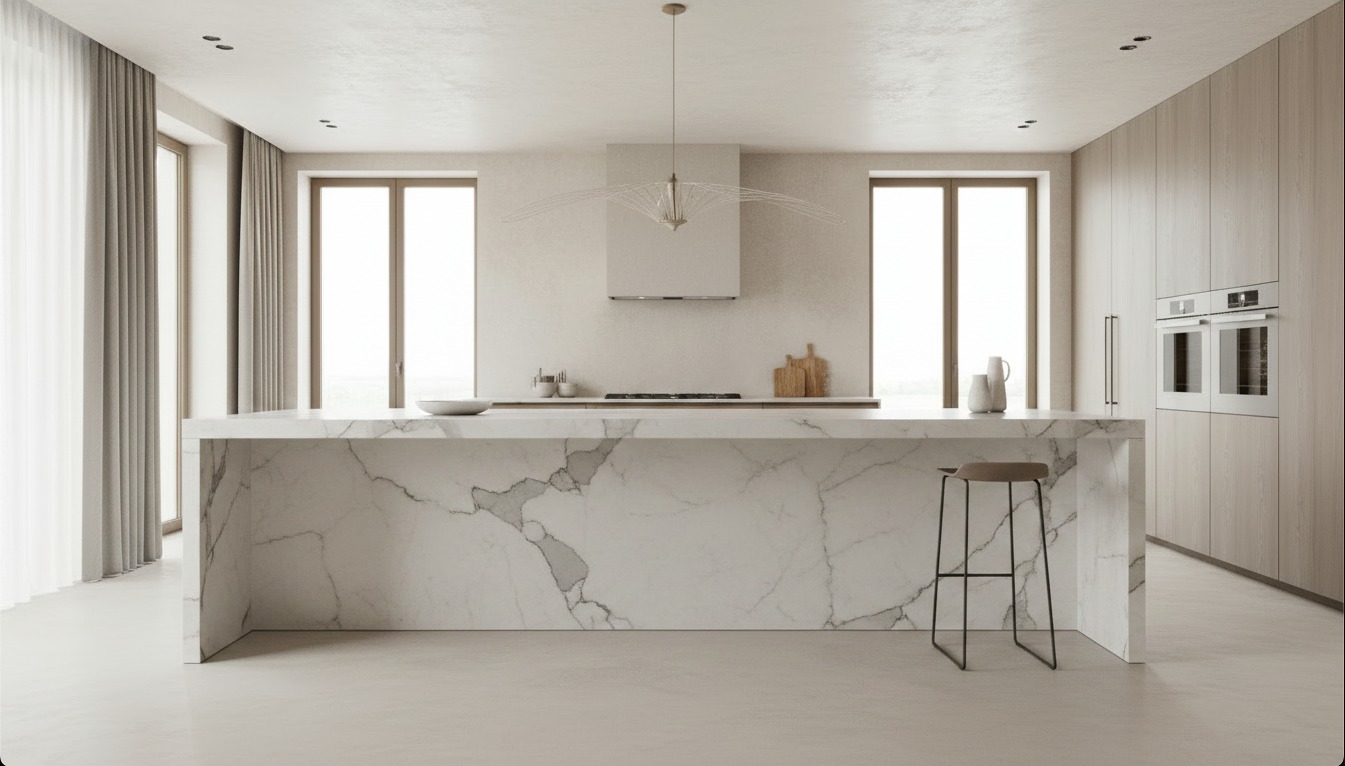
Reports of the waterfall island’s demise have been greatly exaggerated. Fabricators and designers are seeing more requests for the look, not fewer — but the version homeowners want today looks different than it did five years ago, and it’s shaping this year’s kitchen island countertop trends more than any other single feature.
Instead of matching every surface in the kitchen to create one seamless, monochrome block, the current move is contrast. Pair a dramatically veined stone island with warm, solid wood cabinetry. Let the countertop be the loudest thing in the room and let everything else quiet down around it. The effect reads as intentional rather than uniform, and it tends to age better than an all-matching palette that can start to feel flat after a few years.
That said, waterfall edges aren’t a universal fit. In French country, farmhouse, or heavily traditional kitchens, the hard vertical line of a waterfall can fight with the softer, more layered look the style is going for. In those spaces, a waterfall treatment tends to work better on a bathroom vanity or a smaller peninsula than on the main island.
Edge Profiles Are Having a Moment
For years, a clean, minimal eased edge was the safe default. That’s shifting. The ogee edge — the classic S-curve profile long associated with traditional and French-farmhouse kitchens — is being reintroduced into much more contemporary spaces, paired with simple cabinetry and a restrained color palette so it reads as considered rather than dated.
Waterfall edges themselves are also being treated as a decorative element in their own right, not just a structural way to hide cabinet sides. When the stone has a bold, dramatic pattern, designers are dialing back the edge detail so the veining stays the star. When the slab is calmer and more uniform, a more sculpted edge profile can carry more of the visual weight.
The takeaway: edge profile and slab pattern should be chosen together, not separately. A busy edge on a busy stone competes with itself.
Book-Matched Veining as the Real Centerpiece
If there’s one technique separating an ordinary island from a memorable one, it’s book-matching — cutting two slabs from the same block and opening them like a book so the veining mirrors across the seam. Done well, it turns the countertop into something closer to a piece of art than a work surface.
Book-matching isn’t limited to marble anymore. It’s showing up on quartzite and select engineered quartz slabs that replicate natural veining with more consistency slab to slab. For an island, book-matching works especially well on the waterfall sides, where the mirrored pattern draws the eye downward and makes the whole piece feel sculptural rather than flat.
If you’re considering this look, ask to see the full slab (or slabs) before fabrication, not just a sample chip. Veining and movement vary enormously between individual pieces of natural stone, and the drama of a book-matched island depends entirely on the specific slab pair you start with.
Choosing the Material: Granite, Quartz, Marble, and Quartzite
[IMAGE PLACEHOLDER — material comparison] Suggested filename: granite-quartz-quartzite-kitchen-island-countertop-materials.jpg Suggested alt text: “Granite, quartz, and quartzite samples for kitchen island countertops”
Each of the major island materials earns its place for different reasons:
Granite remains the workhorse choice for islands that see real cooking activity. It shrugs off heat from hot pans and holds up to daily wear better than almost anything else on this list, all while offering natural pattern variation. Browse our granite slab selection to see the range of colors and movement available.
Quartz (engineered stone) is the low-maintenance option — no sealing, consistent color and pattern from slab to slab, and increasingly convincing veined designs that echo natural marble without the upkeep. It’s a strong choice for busy households that want the look of movement without babying the surface.
Marble continues its comeback as part of a broader pull toward natural materials that develop character over time. It will patina and can etch with acidic spills, which some homeowners now treat as part of the material’s charm rather than a flaw — but it’s worth going in with eyes open about that maintenance trade-off.
Quartzite splits the difference: the dramatic, marble-like veining people want, with far better resistance to heat, scratching, and etching than true marble. It’s become a favorite for waterfall islands specifically because it can carry a bold, book-matched pattern down the full height of the cabinet without the durability concerns of soft natural stone.
Putting the 2026 Kitchen Island Countertop Trends Together
The islands getting the most attention this year aren’t trying to do everything at once. They pick one dramatic element — a bold vein pattern, a book-matched waterfall, a revived ogee edge — and let the rest of the kitchen support it. Trying to layer all three at once tends to overwhelm a room; choosing one and executing it well is what makes an island feel custom rather than trend-chasing.
Before you commit to a slab, it’s worth seeing the material in person and, ideally, laying out a full-size template against your cabinet plan. Veining that looks striking on a small sample can read very differently across a nine-foot island, and the only way to know for certain is to look at the actual piece of stone that will end up in your kitchen. Our full collection of kitchen countertop slabs is a good place to start narrowing down options.
If you’re in the early stages of planning, our team can walk you through slab options in person — including book-matched pairs, quartzite in warm and cool tones, and engineered quartz lines built to mimic natural veining — so you can see exactly how a piece will look before it’s cut.
Frequently Asked Questions
Are waterfall kitchen islands still in style for 2026? Yes. Designers report growing demand for waterfall islands, though the look is trending toward bold, contrasting stone against warm cabinetry rather than an all-matching, monochrome finish.
What is a book-matched countertop? Book-matching is a fabrication technique where two slabs cut from the same stone block are opened like the pages of a book, so their veining patterns mirror each other across the seam — creating a symmetrical, high-impact pattern often used on waterfall island sides.
Is quartzite or marble better for a kitchen island? Quartzite offers a similar dramatic, veined look to marble but with significantly better resistance to heat, scratching, and etching, making it a popular choice for high-use islands. Marble remains a favorite for its natural patina, but it requires more careful maintenance.
Do waterfall edges work in every kitchen style? Not always. Waterfall edges tend to suit modern, transitional, and contemporary kitchens best. In farmhouse or French country-style kitchens, designers often reserve the waterfall treatment for a smaller peninsula or bathroom vanity instead of the main island.